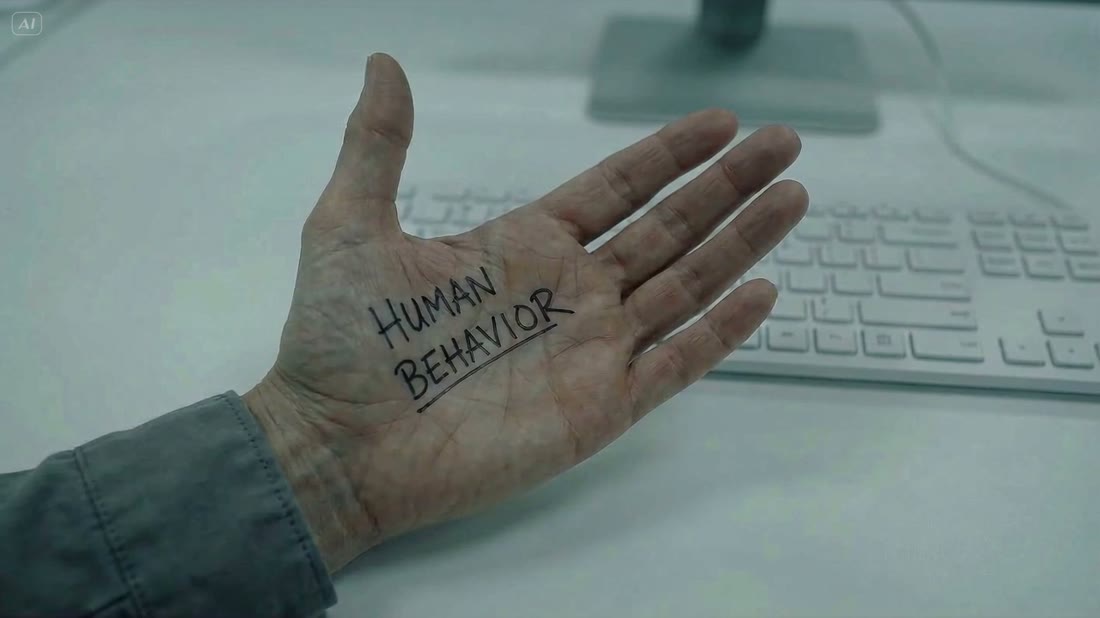
Every other shot in the film is silent narration and interior weather. Shot 5.4 is where Irene speaks for the first time and acts for the first time, in the same breath. She has spent the film reviewing flagged phrases at a Compliance Bureau, approving the deletion of language on command. Now the phrase she secretly wrote on her own palm the night before, human behavior, comes up in the queue, flagged for removal. She whispers it aloud, the first words anyone has heard her say, and she clicks DENY instead of APPROVE. The screen answers with ERROR. This breakdown follows that one shot through the exact pipeline that produced it, because the shot is small and the method behind it is the thing worth teaching.
01Audio first, always
The shot did not begin with a picture. It began with sound. The single line of dialogue, "human behavior," was recorded and placed on the timeline before a frame existed, and it was deliberately kept barely audible, a breath more than a sentence, so that the act of speaking would feel like something escaping rather than something declared. Under it sits the shot's real engine, the sound design of the mechanical leg, which through the whole film has tapped an off rhythm beneath Irene's desk and now, the instant she defies the system, erupts into rapid arrhythmic clicking, a grinding alarm, a heartbeat pushed into distortion. The picture was cut to that audio, not the other way around. Fixing the rhythm in sound first is what lets a generated four-second clip land on an exact emotional beat instead of drifting, and it is the single discipline that most separates authored AI film from a reel of pretty motion.
IRENE (barely audible): "Human behavior." It is the only dialogue she speaks in the film, and it is the phrase the system has marked for deletion. The whisper is the performance.
02Where the words came from
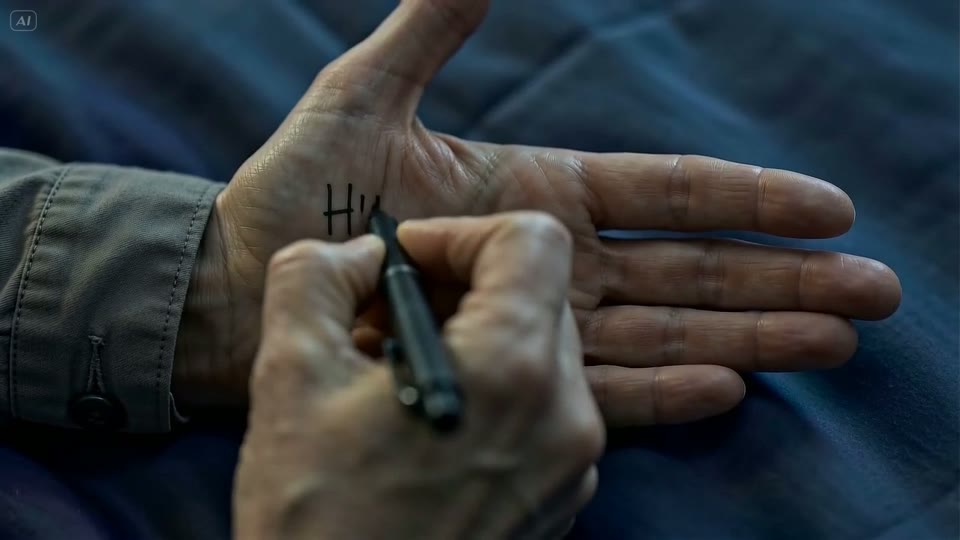
The shot only carries its weight because of a setup planted an act earlier. The night before, alone in her apartment with the surveillance still active, Irene wrote the forbidden phrase on her own palm in ink, one slow letter at a time, then closed her fist around it. That shot, 4.7, is the slowest in the film by design, and it is the reason the bureau climax reads as a payoff rather than a stunt. The teaching point is structural: a climax is built by what precedes it, so the same writing, the same hand, the same words return at the desk where language goes to die.
03The start frame, written as a prompt
With the audio fixed, the picture begins as a single still, generated to a precise written brief and reviewed before any motion is attempted. The image prompt is not a wish, it is a shot description with camera, light, and blocking specified, so the frame arrives already composed rather than discovered by luck. Note that the prompt names the cold cyan of the system against the warm amber of the flagged word, the film's entire visual thesis compressed into one frame, and it fixes a seven degree Dutch angle, the most unstable framing allowed in the bureau, because the world is tilting under her.
Split composition: medium close-up of a woman at a workstation, her face and her screen visible. On screen: the amber-flagged phrase HUMAN BEHAVIOR with APPROVE and DENY buttons. Her cursor hovers over DENY. Her lips are slightly parted, about to whisper. Cyan and amber light on her face. 7-degree Dutch angle. Digital grain. 16:9.
04The motion, directed not prompted
Only once the start frame is approved does the shot move, and the motion brief sequences the beats in time rather than asking for generic action. The camera holds. Her lips move barely. The finger clicks. The amber resolves to a red ERROR. Her expression does not change, which is the direction that matters most, because the refusal is internal and the face must not perform it. Then the second click, and the leg erupts in sound while coworkers turn. This is direction, not prompting: a fixed duration, a named sequence of micro-actions, and an explicit instruction about what the performance must withhold.
Medium close-up. A woman at a workstation. Her lips move barely, whispering two words. Her finger clicks the mouse decisively. The screen flashes. ERROR in red replaces the amber. Her expression does not change. She clicks DENY again. Her mechanical leg erupts with sound beneath the jumpsuit, rapid arrhythmic clicking. Coworkers turn. 4 seconds. 16:9.
05The controls that make it hers
Two director-grade controls keep the shot inside the film rather than inside the model's defaults. The first is the element set, a locked reference for Irene's likeness, her face, the short dark hair, the angular features, the rightward lean, carried shot to shot so she is unmistakably the same person at the apartment and at the desk. Scene 5 binds Set A, the bureau version with the mechanical leg concealed beneath the jumpsuit, because the audience now knows what the leg is even though the coworkers do not. The second control is the negative space, the explicit list of what must not appear: no visible leg, no dramatic reaction, a whisper that stays a whisper. Authorship in generative film lives as much in what you forbid as in what you request.
06The finish, where it becomes a film
The generated clip is not the deliverable. It is the raw stock. The last mile is what separates an experiment from a film, and it is treated as non-negotiable. The footage was upscaled in Topaz to resolve detail and stabilize it across frames, enhanced in Magnific so the image reads as photographed rather than rendered, and conformed and graded with Lumetri so that color does the narrative work the script asked for. The grade is the mechanism, not the decoration: the clinical cyan of the system is pushed against the warm amber of the forbidden phrase, and when the system seizes control the only warm thing left in frame is the red of its command, the world reduced to the machine ordering her to stay where she is.
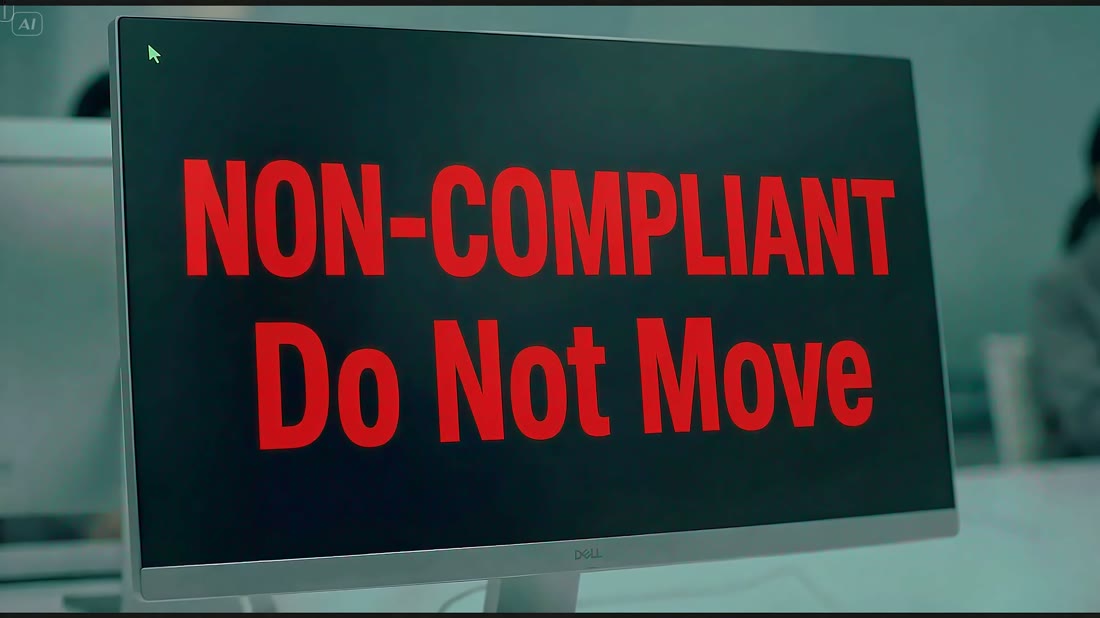
Read end to end, shot 5.4 is a complete pipeline compressed into four seconds. Sound was authored first and the picture was cut to it. The frame was written as a brief, reviewed, and only then set in motion. The character was held to a locked reference and a list of refusals so the performance stayed the director's rather than the model's. And the finish carried the film's central opposition of warm and cold all the way to delivery. The model that generated the clip is interchangeable, and was in fact one of several used across the film. The method is the asset, and the method is portable to the next shot, the next scene, and the next film.
Authorship survives the move to generative tools when the tools are subordinated to a rhythm and a grammar fixed in advance: audio first, frame as brief, character locked, refusals named, and a grade that means something.